here are nearly 21,000 veterans in Onondaga County; more than 300 of them are students at Syracuse University.
In their honor, SU held its annual Veterans Day ceremony at the National Veterans Resource Center (NVRC) Wednesday.
Veterans have shaped Syracuse for generations. After World War II, the university welcomed more than 10,000 veterans under Chancellor William Tolley, who served on the presidential committee that drew up the original GI Bill.
In 2021, then-Vice Chancellor for Strategic Initiatives and Innovation J. Michael Haynie, now chancellor, led the creation of the NVRC, which is home to the D’Aniello Institute for Veterans and Military Families, the Office of Veteran and Military Affairs and Syracuse University’s Reserve Officers’ Training Corps (ROTC) programs.
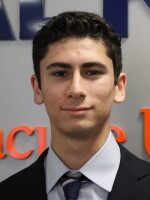
The center was designed for young adults like Marine veteran Keanu Spindola, who, after training to work on military vehicles and living the regimented life of a Marine, said he found it difficult to return to civilian life.
“One day, you know, I was a Marine, and the next day I wasn’t,” he said, knowing few people who could relate. “I have to figure out: how do I be normal again? How do I integrate back into civilian society?”
Originally, Spindola said he hid his military identity to avoid rejection by others, but therapy and enrollment in higher education allowed him to talk with other student veterans and see he was not alone.
“It’s talking to people, having conversations like this to figure out who the people are without the uniform,” he said while standing in SU’s NVRC breezeway.
As a first-generation American with Mexican parents, Spindola has called the military’s diversity “a great equalizer” that needs continued attention.
“One of the beautiful things about the military is I serve with people from all kinds of creeds, colors, backgrounds, economic upbringings,” he said.
Diversity was the theme of the ceremony, during which the Hendricks Chapel Choir performed a South African-inspired choral arrangement of “San’bonani” and “Namhla Kudibene” from the balcony of the K.G. Tan Auditorium.
Chancellor Haynie, an Air Force veteran himself, was the keynote speaker at Wednesday’s ceremony, where he urged universities to go beyond supporting veterans out of obligation and to help them become better integrated in society.
When veteran programs are treated as an inconvenience, he told the room, it “quietly says that veterans are people who we do something for rather than people who can do something for us.”
He pointed out that the evidence and data show that U.S. veterans are often far more prepared to lead.
“Student veterans both here at Syracuse and across the nation outperform other students on almost every metric that we measure in higher education: persistence, graduation, GPA, service, campus engagement,” he listed.
Amid national polarization during America’s 250th anniversary year, and a little over a week after the elections, Spindola, now a graduate student at the Maxwell School of Citizenship and Public Affairs, acknowledged that young Americans may be unsure about joining the military.
“I would encourage the youth to be the change that they want to see,” he told his peers. “The skills, the character development that you get at the end of the day, to me personally, that outweighs the cost.”
Haynie told the crowd that veterans do not all think the same, but do care for one another.
“They vote differently. They pray differently; they build and have built a kind of trust that today many of us struggle to build with our own neighbors,” he said.
For civilians wondering what they can do to return the favor to a veteran who served their country, the chancellor had one request.
“Ask a classmate, a colleague, a neighbor about their service,” Haynie said wrapping up his keynote speech. “And then listen.”